March 20, 2010

Week 4: Grilled Calamari with Beans and Chorizo

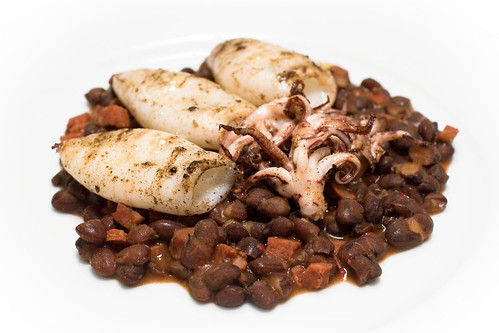
Up this week is yet another Contigo-inspired dish. One of many great dishes we had during my birthday dinner was calamari cooked a la planxa (on a flat top) with red tolosa beans, chorizo, and allioli. It was one of our favorite dishes that night (along with the scallop and black rice dish).

For our version, I used San Franciscano beans from Rancho Gordo. I hadn't tried them before, but I was told they were similar to Rio Zape beans, which would pair well with chorizo.

After a quick soak, I simmered the beans for a few hours with some onions that had been cooked in a little lard (recovered from Boccalone pancetta). Then I seared some diced Spanish chorizo and used the oil to cook some minced onion, celery, and red bell pepper. After returning the chorizo to the pan with a splash of beer, I added the mixture to the bean pot and let the beans finish cooking for about an hour, reducing the broth to a nice sauce.

When I need squid, I usually go to Sun Fat for fresh, local squid. It tastes better than the frozen squid, and I can do a more careful job of cleaning it than the commercial stuff. (BTW, squid is dirt cheap. I often feel bad walking out of there having only spent a few bucks.) Unfortunately, they'd run out of it on Saturday, so I had to use frozen squid instead. The squid got a quick marinade in some olive oil, lemon zest, and paprika before hitting the grill pan. Despite being previously frozen, I managed to get a little bit of caramelization and a nice hint of the paprika.

The final component of the dish was the allioli, which didn't quite work out for me. According to Wikipedia, it is the Catalan version of aioli that uses only garlic, olive oil, and salt. Via some mortar and pestle magic, you're supposed to be able to emulsify garlic in oil without using any egg yolk. I found a video of it being done, but I didn't quite pull it off. I started out with the mortar and pestle but was having trouble getting it to work right. So I gave up on the mortar and pestle and switched to my Cuisinart mini-prep. That didn't work because the portion was too small to get the garlic into the blades. At this point, I knew I was pretty much screwed, so I tried the blender. The blender looked like it was working, but the resulting sauce didn't have the right texture and quickly separated. I did end up with a nicely garlic-flavored olive oil, which I spooned on top. After a subsequent visit, I think Contigo is using a little egg yolk to help the emulsification (and possibly a little lemon juice to balance flavors), so I'll probably do that next time to get the texture I want.

Overall the dish was quite good. We'll definitely make it again, probably with some chorizo-laced black rice instead of beans, so I can make it on a weeknight. The beans did turn out really well, though. I will be making them again too.

March 11, 2010

Week 3.5: Duck Redux - Spice-crusted duck breasts with bacon bonbons and arugula

On Wednesday I cooked the rest of of the duck from last weekend. In the process I managed to kill two birds with one stone. (Pun intended.) Since we had this mid-week, I wasn't sure if we'd count this as the week four dish or not. It turns out that we made another new dish on Sunday, so I think I'll call it week 3.5, keeping with the duck theme of last week.

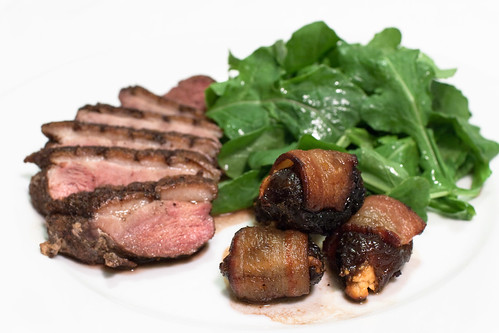
I combined two dishes that Emily has been asking me to make. The first is pan-roasted duck breasts with prunes, inspired by the Contigo dish, "Seared Duck Breast with tea-steeped prunes, toasted almonds, cardoons, and arugula."  And the second dish is the a take on the bacon bonbons that we order every time we go to Gitane. We've been talking about making them ever since we first had them a year ago. They stood in for the prunes in the original Contigo dish, and I used the port sauce on both the duck and the bonbons.

The Gitane menu describes the bacon bonbons as "sautéed prunes stuffed with goat cheese, wrapped in smoked bacon, anise and cinnamon port sauce." A little research turned up a similar a British bar food called Devils on Horseback and hints of a similar a french appetizer. In the Gitane version, the bacon, prunes, and cheese are a perfect combination and the rich sauce, melding savory and sweet, ties everything together well.

I found the duck breast recipe in One Spice, Two Spice, a book by an Indian chef who does Indian / western fusion dishes. He uses a star-anise and allspice rub, which I thought would match well with the prunes and sauce. He also adds some ginger, rosemary, and garlic at the end for basting. I served the duck with a simple salad of arugula, goat cheese, and a balsamic vinaigrette (with good balsamic). The goat cheese is not pictured, because I decided to add after we tasted the dish. In the future, I'd also add some almonds to the salad.

For the bacon bonbons, I consulted a few recipes for Devils on Horseback on the web, but I had to guess on the sauce. I decided to use some duck stock and port wine in a 3:1 ratio, reducing the port before adding the stock. I added a little of the spice rub I used for the duck and let the prunes simmer in the sauce as it reduced. I then strained off the sauce. When the prunes cooled, I stuffed them with cheese and wrapped with bacon. I arranged them on a silpat, with the overlapping bacon side down, and stuck it in a 400 degree oven for 20-25 minutes until the bacon was crisp.

Or at least, that was the plan – halfway through the cooking process, the bacon shrunk and most of the bonbons came unwrapped. So I pulled them from the oven, skewered them back together with toothpicks, and stuck them back in to finish cooking.

The one big problem with the meal was that I'd over-salted the duck. The recipe had called for putting the rub on the duck (containing salt) and then salting it again when you put it on the pan. It sounded like a bit too much salt, but did it anyway. Aside from being too salty (which was distracting), the duck was quite good. The spices went well with the duck, and the salad complemented it nicely. The bonbons also went well with everything. I don't think Emily will let me get away with making this dish again without them.

Next up is grilled calamari with chorizo and San Franciscano beans. Also Contigo inspired – someday I should put together a post of all my restaurant-inspired dishes.

March 08, 2010

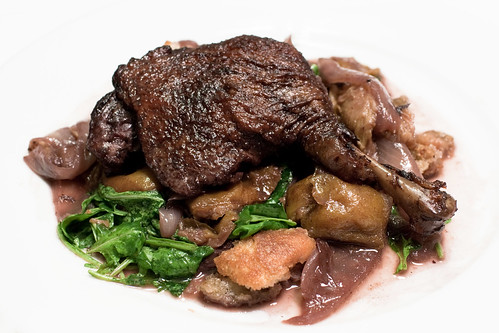
Week 3: Braised duck legs with red wine and prunes

This week I made braised duck legs with red wine and prunes. Emily wanted me to do something with duck breasts and prunes, similar to a dish we had for my birthday at Contigo. Unfortunately, it was the one time we didn't take photos at Contigo.

I've been looking forward to working with duck again. It has been a while since I've used it. A few years ago, I made confit of duck legs and prosciutto out of a duck breast. A little more recently, I made cassoulet and tacos out of duck confit. But I haven't had a lot of practice with fresh duck. It's a little different from chicken, there is a bit of fat to deal with and you need to leave it medium rare to keep from drying it out. (Unless you confit it.)

Since I've never cooked duck breast before, I did a little research to see how it was typically done. (Score the skin, slowly cook, skin side down.) While researching options, I came across a braised duck leg and prune dish in the Zuni Cookbook. It was a completely different dish from the Contigo one, but had similar flavors, so we decided to give it a try.

Sunday morning I went to Drewes Bros to buy a couple of legs for the dish, but I impulsively decided to get a whole duck. I figured I could cook the breasts for dinner later in the week, make some stock out of the bones, and render the fat for potatoes. They offered to break it down for me, but I wanted some practice, so I took it home whole and broke it down myself.

When I went shopping for ingredients I saw some fresh prunes and decided to use them in place of dried ones. The recipe wasn't specific, aside from insisting on the prunes having pits. The other deciding factor was that dried prunes make me a little nervous. They tend to be sold in open bins alongside nuts, and I always assume that little care is taken to prevent cross-contamination. Next time, I think I'll use dried ones both for color and a more concentrated flavor.

The duck was plated on a bed of arugula and the fried bread croutons from the Ad Hoc cookbook, along with the sauce, onions, and prunes. The arugula ended up wilting a bit more than we wanted, so I'd plate the salad next to the duck next time.

Tomorrow we'll have the breasts. I'm using the spice-crusted duck breast recipe from One Spice, Two Spice (allspice and star anise crusted). I'm also going to try to replicate the bacon-wrapped, chèvre-stuffed prunes from Gitane to accompany it. And maybe a simple salad to round out the meal.

March 02, 2010

Week 2: Asparagus and Robiola risotto.

For week 2 of my cooking project, I made an asparagus risotto with a dollop of Robiola cheese in the middle. This dish was inspired by a risotto we had at Beretta. It's been on our to-do list for quite a while, waiting until spring when asparagus would come back in season. Since asparagus has started to show up on menus again, I decided it was time to make it.

Robiola is not something I've seen at the corner stores, so I figured I'd have to do a little hunting for it. Fortunately, they had some at our closest cheese shop, the 24th Street Cheese Company. They're a short walk away and have a good selection of cheeses. The Robiola turned out to be a little more expensive than I expected, but once I got it home and sampled it, I decided it was worth the price. Yes, it smells slightly of gym socks, but it's incredibly rich, creamy, and tangy.

Although I improvised the recipe, I did take a look at one in Boulud's book. He took asparagus risotto in a slightly different direction, inflecting it with lemon and lime juice, but I did follow his suggestion on how to cook and introduce the asparagus to the dish – peeled, blanched, and warmed in butter. My educated guess would have been to blanch them and add them to the risotto for the last 2 minutes of cooking, but you can't go wrong with butter. My changes included shortening the blanching time, because I had skinny asparagus, and cutting the stems on the bias rather than into coins to give them a fun shape. And I'm still wondering if I should have caramelized them in a hot skillet instead just reheating them in butter.

For the risotto itself, I used shallots and arborio, deglazed with dry vermouth, and cooked with court bouillon. I finished it with parmesan and a squeeze of lemon juice. At Emily's suggestion, I also mixed in a little of the Robiola. Then I added the reheated asparagus and plated it with a dollop of Robiola in the middle.

We were very happy with the results, but I think I'd add a bit more asparagus next time. We've got more Robiola, despite my snacking, so we'll be making another batch soon.

February 23, 2010

Week 1: Lamb and Beans

Sometime last week, Emily decided that I should start cooking a new dish every weekend. Since both my to-do list and my cookbook collection have been growing way too fast, I agreed. Last weekend we had our first installment.

After a busy week at work, I didn't really put much effort into research. One morning I flagged a bunch of recipes in Michael Symon's book, and Emily followed up with a bunch in the Café Boulud Cookbook. I flipped through her choices and settled on a "Lamb Haricots" dish from the Café Boulud book. I like lamb and beans, and Emily doesn't usually go for stewed or braised dishes, so I thought I'd give it a try.

I was a little uncomfortable with the recipe after I started putting it together. It seemed to call for way too much liquid: 10 cups of liquid for 1 cup of soaked, dried beans, double-sealed in pot. Yet the instructions mention the possibility of needing more liquid. Also, the vegetables were to be cut in large chunks, but there was no mention of either removing or plating them.

After almost two hours in the oven, I uncovered the dish, hoping to reduce the liquid a little. At about the two hour mark, I ended up pulling the lamb; it was super tender, and I didn't want it to fall apart. The beans weren't done, so I gave them another 30–45 minutes. I still wasn't happy with the beans, but the broth was good. At this point it was getting late, so I reheated the lamb in the broth and plated.

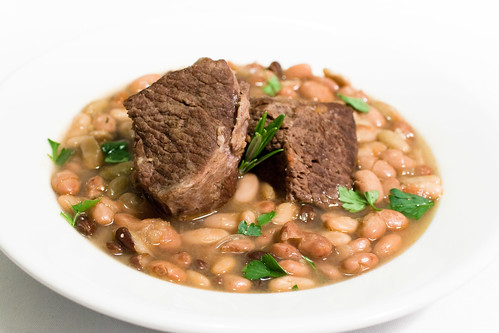
So I fished out some beans, strained on some of the broth, added a few chunks of lamb, and garnished with parsley. I also strained some broth on top of the lamb, but it dried out again by the time this picture was taken.

In the end, the broth was really good, the beans were just short of being done to my taste, and the flavor didn't seem to penetrate the lamb very well. For leftovers I added bacon, broke up the lamb, and cooked it for another 30–45 minutes. The leftovers were decent, but the beans were still not quite right.

In the end, I have much better uses for lamb shoulder, so I doubt I will make this again.

February 15, 2010

Valentine's Day 2010

For Valentine's Day, in lieu of going out to a crowded restaurant, we like to stay in and have a fancy dinner at home. It's the one time of year when I take the time to do excessively fancy dishes that just aren't practical to do every day at home. Typically, Emily will pick out a fancy dessert that reminds me that I am not a pastry chef, and we come up with a couple of savory courses to go with it. The meal usually includes "Oysters and Pearls" from the French Laundry Cookbook and an entrée.

This year I went a little overboard and spent most of the weekend cooking.

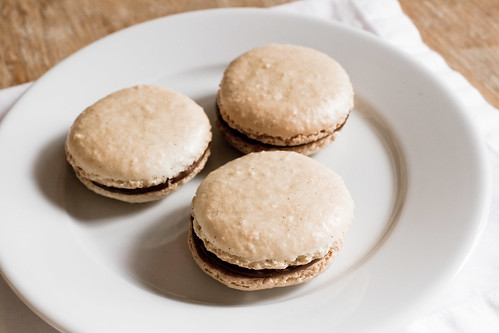
On Sunday morning, I made macarons as a surprise for Emily. I used the recipe from the Bouchon Cookbook for the cookies and filled them with the chocolate/caramel buttercream from our dessert. The dough spread a little, yielding larger cookies, but I think they turned out well for a first attempt. (The buttercream was a little loose too, making them messy to eat at room temperature.)


As an amuse bouche, I also made a small (1-egg) batch of gougères—cheese puffs made with Comté cheese. I wasn't planning on making them, but they're pretty easy to throw together and have been on my to-do list forever. They turned out fairly well but were a little denser than I'd like. I think the dough needed a little more egg and some tweaks to the cooking time.


For an appetizer, we decided it was about time to try making the Salmon Cornets from the French Laundry Cookbook. They're adorable little savory "ice cream" cones filled with a red onion crème fraîche (French sour cream) and topped with salmon tartare.

It's a great dish, but people on the internet reported having a lot of trouble making it. The tricky part is making the cones themselves. You bake 4" diameter disks of batter in a 400˚ oven until they are just set. Then pull the sheet pan out a little, flip over disks of molten batter, wrap them around conical molds, and finish baking then until they set. To avoid burning myself, I did most of the work with a mini offset spatula. However, I found that I needed to use my fingers to get the disk wrapped around the cone.

The results were worth the effort; it was my favorite dish of the night.


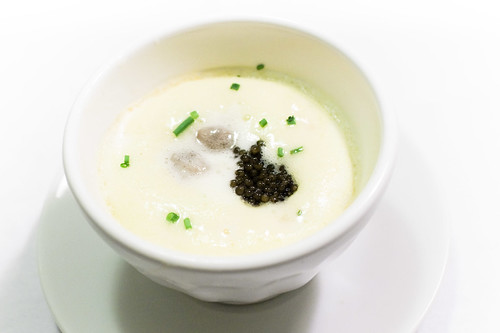
Next, I made our traditional Oysters and Pearls. This year it was good but not as good as previous years. The base was not thick enough, so the oysters sank in, instead of resting on top. (I had extra oysters and managed to get Emily's dish photo-ready by resting a second pair of oysters on top of the first.)

The base is a mixture of pearl tapioca, a savory sabayon (foamy cooked egg yolks), crème fraîche, and whipped cream. On top are two oysters, some caviar, and a foamy beurre blanc containing butter, shallots, chives, vermouth, vinegar, and oyster juice.


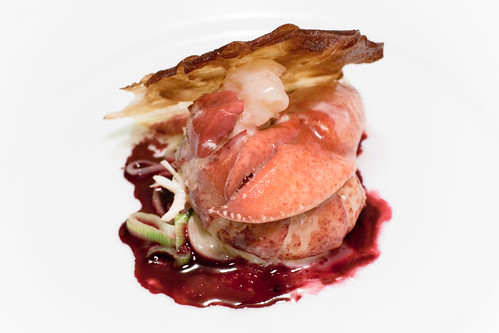
Our main course was another dish from the French Laundry Cookbook: a butter-poached lobster with pommes Maxim (crisp sheets of potato), leeks, and beet essence. Keller likes to steep lobster in hot water for a few minutes to remove the meat and then poach it to order in beurre monté. Beurre monté is essentially a bunch of butter that has been slowly whisked into a tiny bit of water. It is slightly tricky to work with, because it will separate if it gets too hot or too cold.

The pommes Maxim are thinly sliced potatoes that have been coated in clarified butter and baked into a thin, crisp sheet. The result is similar to a solid sheet of buttery potato chip, but I didn't quite get it right. The edges were rather dark but crisp, and the middle was a little leathery. It didn't crisp up right. I think I needed to dry the potato slices and back off on the butter. Nonetheless, I made extra and managed to get some decent pieces from the edge.

The beet reduction was tasty: beet juice reduced to a syrup, with some beurre monté and a splash of red wine vinegar whisked in. The vinegar complemented the sweetness of the beets, and the butter added a nice richness. On top of the sauce was a mixture of leeks, tomato diamonds (Keller cuts tomatoes into little diamonds), and "brunoise"—tiny cubes of carrot, parsnip, and leek greens. The brunoise mixture appears in a lot of French Laundry dishes. This was topped with half of a tail, a claw, and a shard of potato.


Emily chose the "Vanilla Fleur de Sel, Caramel and Chocolate Dobos Torte" from Cannelle et Vanille for dessert. It's a thin sponge cake layered with vanilla fleur de sel, chocolate, and caramel buttercream, topped with milk chocolate chantilly and caramel decorations. The torte itself wasn't terribly difficult, although it did take me a few hours on Saturday to put together.

Pastry is a bit outside my comfort zone, and Emily always finds something challenging for Valentine's Day. Two years ago, it was an Elizabeth Falkner recipe with a dozen components that I had to adjust for her allergies. Last year, it was a layered dessert, also from Cannelle et Vanille, with tempered white chocolate wrapped around it.

The real challenge for me this time was trying to form the caramel rings. The ingredient list for that recipe reads, "sugar." The rest is technique, which I don't have. Working with molten sugar makes me nervous, because it's tricky to work with and can cause severe burns. I carefully melted sugar in a pan until it was liquid and caramelized, then shocked the pan in an ice bath to lower the temperature, trying to get the sugar to just the right consistency so I could drizzle a ring of sugar around a greased metal measuring cup. If it's too hot, it pours too quickly and comes off as you get to the bottom side. If it's too cold, it seems to pour too thickly. Finally, I tried to remove the sugar from the form without mangling or breaking it. It took a lot of tries and some reheating and cooling of the pan, but I finally got a few acceptable rings. (I also got a pan with 1/4" of rock-hard caramel in the bottom.)
April 27, 2009

Rosemary and Ricotta Tart


109/365 ricotta tart by embem30

This tart was inspired by a dessert we had at Contigo in San Francisco. I based the filling on a ricotta/pine nut tart found in Mario Batali's book, Molto Italiano, and the crust is from Michael Ruhlman's book, Ratio.

If you can't find a meyer lemon, use half of a normal lemon. I used Bellwether Farms sheep's milk ricotta, but a cow-milk ricotta would work too.

This is best made in a 9" tart pan, but a pie tin will do. If you use a pie tin, the filling will come up halfway. After it is done baking, carefully trim the crust to be level with the filling. If you're feeling particularly lazy, you could use a store-bought pie or tart crust.

Crust
9 oz All purpose flour (a scant 2 cups)
6 oz butter (1 1/2 sticks)
2 tbsp sugar
2-3 oz cold water (1/4 cup plus 1-2 tbsp)
pinch of salt
pie weights (1/2 lb dry beans)
Filling
1-2 tsp fresh rosemary, finely chopped
8 oz ricotta cheese
1/4 cup of honey
1 small meyer lemon, or half a lemon
2 eggs
pinch of salt

Make the crust: Mix the flour, sugar, and a pinch of salt. Cut up the cold butter into chunks and work into flour and sugar, until you have pea-sized chunks. Try to use a squeezing rather than a rubbing action, so you don't heat up the butter too much. Add 2-3 oz cold water and mix to combine. I used almost 3 oz, but the dough was a little to sticky.

Form into a flat disk, wrap in plastic wrap, and refrigerate for 15 minutes.

Roll and blind bake the crust: Flour your counter and rolling pin, and roll out the dough until it's about as thick as pie crust. To get it onto the tart pan, roll it onto your rolling pin and then unroll it over the pan. Trim the dough, leaving a little bit of overlap around the edges to account for shrinkage.

Cover with the dough with tin foil and add the pie weights. Bake for 15-20 minutes at 375°F. Remove the tin foil and weights.

Assemble the tart: Meanwhile, mix all of the filling ingredients together - I used a tsp or two of finely chopped fresh rosemary. Add both the juice and the zest of the lemon. Taste it and adjust with salt, honey, and lemon juice if necessary. There should be a subtle sweetness.

Pour the mix into the tart shell and bake for 30-35 minutes. The crust should be golden brown. Allow to cool on a rack, then trim the crust to be level with the filling. (Emily saved the extra bits of crust for her morning tea the next day.) Cut into slices and serve with a drizzle of honey.

This can be served at any temperature, but I think it'd be best served warm with a quenelle of ice cream or crème fraîche.


Update: This didn't set up the second time I made this, not sure why. I'll update this post if I figure out the issue.